
It's been a solid 20 years since I started making Mojolevers in my basement and selling them on the internet. It's been a really fulfilling adventure, but it also took quite a bit of my time. I'm middle-aged now, and I want my spend more of my free time (and workbench space) on other things.
Yes! If you've broken or worn out the nylon parts on either end of your Mojolever, please reach out to me at mitch.patrie@gmail.com. Spare parts don't take up nearly as much room as finished Mojolevers, so I plan to keep spare parts around for years to come.

If you've ever changed a motorcycle tire with old-fashioned tire irons, you know where the expression "blood, sweat and tears" comes from. It's hard (and sometimes painful) work. I know, I've used tire irons dozens of times myself, and the rims on my first bike had a lot of "character" to show for it.
The Mojolever combined paint protection and mechanical advantage so that one person could change a motorcycle tire with relatively modest effort. When used correctly, you never needed to pull on the bar with more than one hand. It was three feet long, made of solid steel 3/4" squarestock, and was finished with sandblasting, phosphating, and a thick, durable gloss-black powdercoat.
The demount end featured a nylon sleeve on the tip to protect your rim from scratches, held in place by a high-strength steel 3/8" bolt, coated to resist rust.
The "mount" end included a nylon insert underneath the "hook", again for protecting your rim from scratches. When properly used, nothing but nylon ever touched your painted rims.
If you want to understand how the Mojolever was used, click here to read the instruction manual for it.
If you'd like to see the Mojolever in action, click here to see videos my customers have made and posted on YouTube.
Fred Harmon's 2007 review of the Mojolever can be found here. As you'll note in his review, the Mojolever at that time was fitted with a stainless steel bolt in the "demount" end, and Fred discovered for me that it wasn't strong enough to handle the tires on a Honda Goldwing. After hearing of his experience I stopped using the stainless steel bolt and upgraded to a high-strength, carbon-steel bolt with zinc plating. All Mojolevers sold since 2007 were shipped with that high-strength steel bolt, and they took care of Goldwing tires!
The Mojolever was intended for use on motorcycle tires. Car tires tend to have much stiffer sidewalls than motorcycle tires; as such, I didn't recommend the Mojolever for use with car tires, and didn't warrant it against damage if used in that manner. Having said that, there are YouTube videos out there of the Mojolever being used on car tires, so I know it's been done. I did offer replacement parts for sale to refit the ends of the Mojolever, so it coud be repaired if you did damage it.
To change your own motorcycle tires, in addition to the tools for getting the wheels on/off your motorcycle, you needed three things:
A tire changing stand. The most popular choice was Harbor Freight item #69686, Portable Tire Changer, together with Harbor Freight item #60810, Motorcycle Tire Changer Attachment. As an alternative, any stand that gripped the rim (to keep it from rotating) and included a centerpost (to pivot the Mojolever around) and a bead breaker worked.
One Mojolever. You bought items #1 and #2 from Harbor Freight (see above links), and the Mojolever from me.
A static wheel balancer. I strongly recommend something from Marc Parnes.
Note that if you had the Mojolever, you did not need traditional tire levers ("spoons") at all.
The Harbor Freight changer came with its own tire lever, but it was virtually impossible to use, guaranteed to scratch/gouge your rims, and left bright red powdercoat behind. This was in fact the reason that the Mojolever existed: it worked beautifully, and when used properly it did not scratch your rims. If you want to read more about it, click here for a Google search of discussions about the Mojolever.
Please note: the Mojolever is no longer available! The price was $144, and that included shipping anywhere in the 48 lower United States.
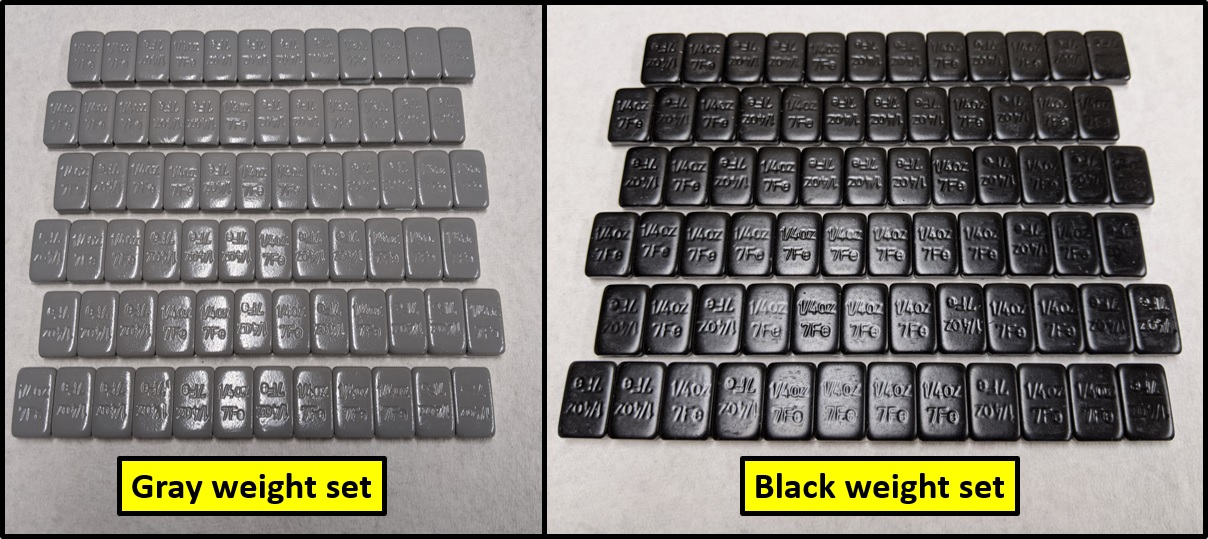
I also offered wheel-balancing weights for a small additional cost. These were adhesive-backed 1/4-ounce squares of polyester-coated steel, 6 strips of 12, and they were available in gray or black::
You can't! The Mojolever is no longer available! Sorry. :-(